
The ultimate trick to keep a class quiet
🎤 Storytelling Speech: The Ultimate Trick to Keep a Class Quiet
🌷 Dear Judges,
Respected Teachers and Beloved Colleagues,
When speaking of our teaching practicum days, each of us student-teachers carries unforgettable memories—those first awkward lessons, the innocent yet mischievous eyes of students, and the moments that made us realize: to be a teacher, sometimes knowledge alone isn’t enough… you also need a bit of creativity.
Today, I would like to share a small memory that taught me a big lesson.
The story is titled: “The Ultimate Trick to Keep a Class Quiet.”
It was one sunny afternoon at Dao Duong Secondary School, where I was doing my teaching practicum.
That week, our group of student-teachers was assigned to supervise the weekly homeroom session for the 9th graders.
Everyone was excited, but we couldn’t hide our worries. Because grade 9—according to the teachers—was a “challenging land.”
The students were energetic, playful, and… could talk all day without getting tired!
My heart pounded when I heard that. I wasn’t good at yelling, nor did I want to use punishment or strictness to force obedience. But eventually, my homeroom period arrived.
When I entered the classroom, I was greeted by utter chaos: talking, laughing, paper balls flying everywhere. I tried to smile and gently said:
— “Hello everyone! Today I’ll be supervising your class.”
The whole class responded, “Yesss, sir!” and then… went back to being noisy.
I tried tapping the table, raising my voice—nothing worked.
I stood still for a moment, took a deep breath. And then, a bold idea popped into my mind.
I asked:
— “Where is the class choir leader?”
A soft voice replied:
— “Here I am, sir.”
I smiled:
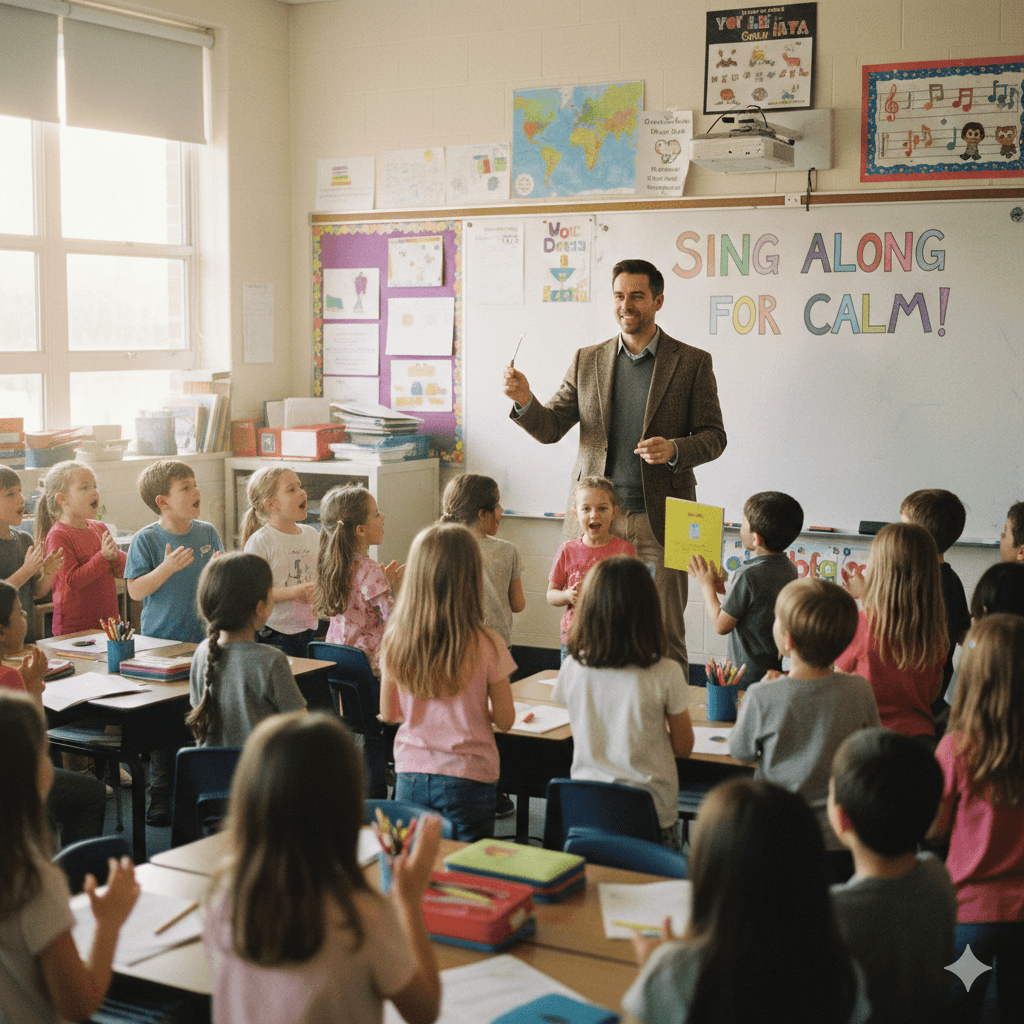
— “Please have the class sing a song. Any song. But everyone must sing loudly!”
The class burst into laughter. They probably thought, “This trainee teacher is weird.”
But then the singing began—at first scattered, then gradually merging into a cheerful melody.
“Joining hands in unity” filled the room. Some students sang passionately; others laughed; some clapped along.
And then… something magical happened.
After the song ended, the entire class grew quiet. No more chatter—just gentle smiles and adorable eyes.
I quickly took the chance to talk to them. The atmosphere became strangely calm and friendly.
But after a while, the whispering sounds started again. I smiled, looked at the choir leader, and whispered:
— “Let’s do one more song, please.”
This time it was “Chalk dust.”
The class sang—more softly, but more emotionally.
When the song ended, one tired student joked:
— “Teacher, you made us sing two songs in a row. We’re too tired to talk now!”
I burst out laughing and simply replied:
— “That’s perfect then!”
Right at that moment, the principal happened to walk by. He stopped and looked inside—students sitting neatly, completely silent, and I was talking without raising my voice. He smiled and nodded before walking away.
That afternoon, during the student-teacher meeting, the principal said:
“I want to praise Class 9B. The student-teacher supervising them used a very scientific method—no yelling, no punishment, yet the students remained orderly and cooperative.”
The whole room applauded. I just smiled, not daring to admit that this “scientific method”… was simply singing until they got too tired to talk!
From that afternoon, I realized a simple yet profound truth:
“A teacher doesn’t always need a loud voice. Sometimes, a little cleverness, a little understanding—and the right song at the right time—is enough to bring peace to a classroom.”
That was the first lesson where I truly felt like a teacher—not because of authority, but because of warmth, gentleness, and belief in my students.
And perhaps, the melody of “Chalk dust” on that sunny afternoon will forever remain the warmest song in my journey as a teacher.
Dear teachers,
Sometimes, a smile can replace a scolding, a song can replace a ruler, and a loving heart can replace strict rules—
That is what makes the teaching profession beautiful.
Thank you very much! 🌷

How do you think about this storytelling speech?